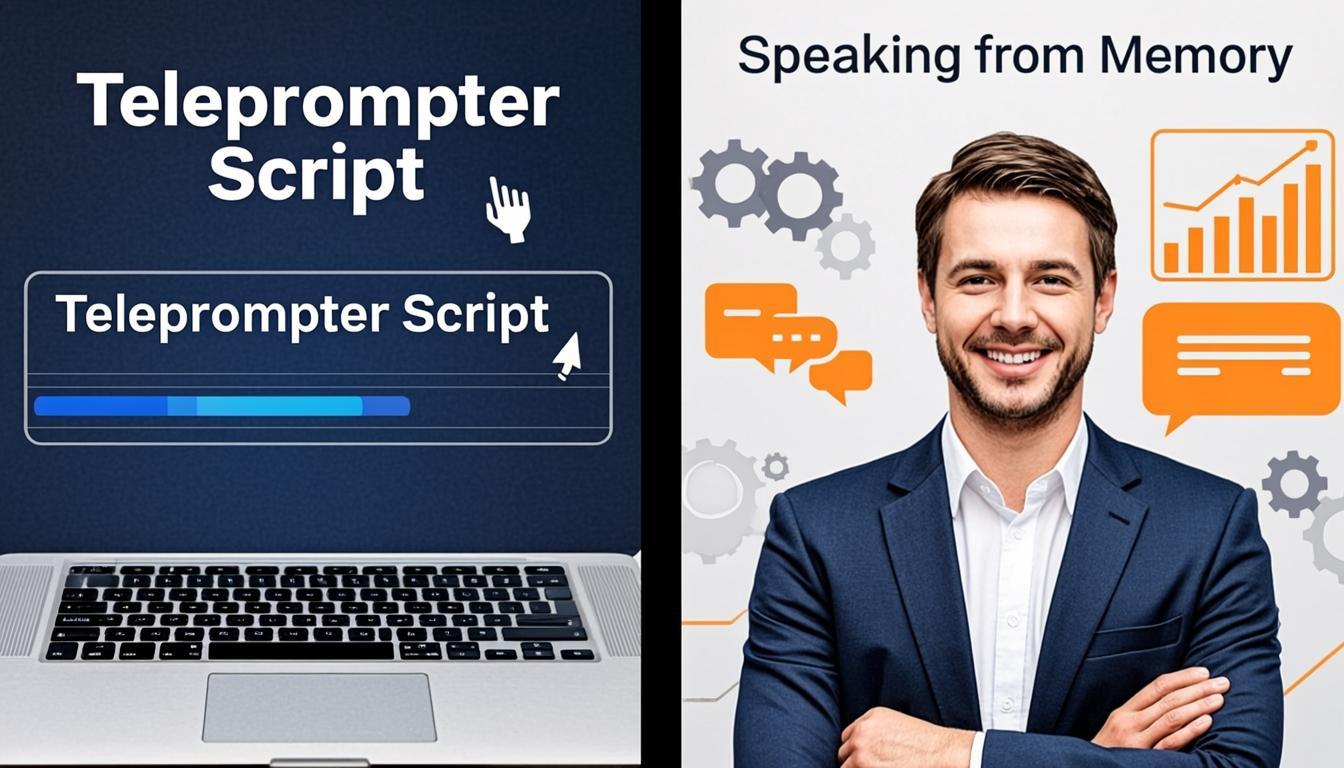
Teleprompter vs. Memorizing: Which Works Better for Videos?
Should you memorize your videos or use a teleprompter? After years of testing both approaches, here's my honest take on what works best and when.
This is one of the most debated questions in the content creation world, and I've seen passionate arguments on both sides. Some creators swear by memorization and wouldn't touch a teleprompter with a ten-foot pole. Others use a prompter for every single video and can't imagine working any other way. After years of producing content using both approaches, and after coaching dozens of creators through their own workflows, I can tell you this: neither approach is objectively better. The right choice depends entirely on the type of content you're making, your natural strengths as a presenter, and the constraints of your production process. Let me break down the honest pros and cons of each approach and then share the hybrid method that I think works best for most creators.
The Case for Memorization
Memorization produces the most natural-looking videos, period. When you genuinely know your material, you speak with conviction, make natural eye contact with the camera, and your body language is relaxed and authentic. There's a visible difference between someone who is recalling something they truly understand and someone who is reading words off a screen. Audiences can feel it, even if they can't articulate exactly why.
Memorization also gives you complete freedom to deviate from your plan. If a better way to explain something occurs to you mid-recording, you can take it without having to stop and rewrite your script. This spontaneity often leads to some of the best moments in a video, the kind of off-the-cuff insights that make content feel fresh and original.
For short videos under three minutes, memorization is absolutely the way to go. Most people can memorize a few paragraphs of content with reasonable effort, and the result is a tight, energetic video that feels completely natural. If you're making TikToks, YouTube Shorts, or Instagram Reels, take the time to memorize your key points and deliver them without a prompter.
The downside of memorization is the time investment. Memorizing a ten-minute video script can take hours, and if you need to re-record sections, you have to re-memorize them as well. For longer content, memorization becomes impractical for most people. You also run the risk of forgetting your lines mid-take, which leads to frustrating restarts and can shake your confidence on camera.
The Case for Teleprompters
Teleprompters excel at one thing above all else: consistency. With a teleprompter, every take is exactly the same, which means you can record a fifteen-minute video in a single take if your delivery is smooth. For longer content, this is a massive time saver. A video that would take three hours to record using memorization might take thirty minutes with a teleprompter.
Teleprompters also let you write more complex, nuanced scripts. When you don't have to worry about memorization, you can include specific statistics, precise wording, detailed explanations, and carefully crafted transitions. This is particularly valuable for educational content, technical tutorials, and any video where accuracy matters.
For creators who produce content frequently, teleprompters offer a sustainable workflow. You can write a script, record the video, and move on to the next one without spending hours in the memorization phase. This consistency is what allows high-volume creators to maintain their publishing schedules.
The main drawback of teleprompters is the learning curve. Reading from a prompter while maintaining natural eye contact, expressive delivery, and conversational tone is a genuine skill that takes practice to develop. Beginners often sound robotic or stiff, and their eyes visibly track the text in a way that's distracting to viewers. It takes weeks of regular practice before most people start to look natural on a teleprompter.
The Bullet Point Middle Ground
There's a third option that sits between full memorization and word-for-word teleprompter reading: the bullet point approach. With this method, you create a list of key points or short phrases that outline what you want to cover, and you speak naturally around each point without a full script.
This approach gives you structure without the constraints of a word-for-word script. It's faster to prepare than memorization because you only need to learn the key points, not the exact wording. It also feels more natural than teleprompter reading because you're genuinely speaking in your own words rather than reading someone else's.
The problem with bullet points is that they can lead to rambling. Without a script to keep you on track, it's easy to spend too long on one point, go off on tangents, or forget to mention something important. Your video might be engaging, but it'll also be longer and less focused than it could be.
My Recommended Hybrid Approach
After trying all three methods extensively, here's what I recommend for most creators: use a hybrid approach that combines the structure of a teleprompter with the spontaneity of memorization.
Write a full script for your video, but treat it as a guideline rather than a strict manuscript. Load it into your teleprompter and use it as a reference while recording. Don't try to read every word exactly as written. Instead, glance at the prompter to get the next idea, look at the camera, and express that idea in your own words. If a sentence feels awkward when you try to say it, improvise a better version on the spot.
This approach gives you the safety net of a complete script while preserving the natural delivery that comes from speaking in your own words. If you get stuck or lose your train of thought, the prompter is right there to get you back on track. If inspiration strikes and you think of a better way to explain something, you're free to follow it.
For the opening hook and closing call to action, memorize those sections word for word. These are the most important parts of your video and benefit from polished, precise delivery. For the body content, use the teleprompter as a loose guide.
When to Use Each Method
Use memorization for short videos under three minutes, emotional or personal content, and any video where authenticity is more important than precision. Use a teleprompter for videos longer than five minutes, technical or educational content, and any situation where you need to produce content quickly and consistently. Use bullet points for videos where you have deep expertise on the topic and can speak confidently without detailed notes.
The best creators I know don't rigidly stick to one method. They choose the approach that best serves each individual video, and they're skilled enough with all three to switch between them as needed.