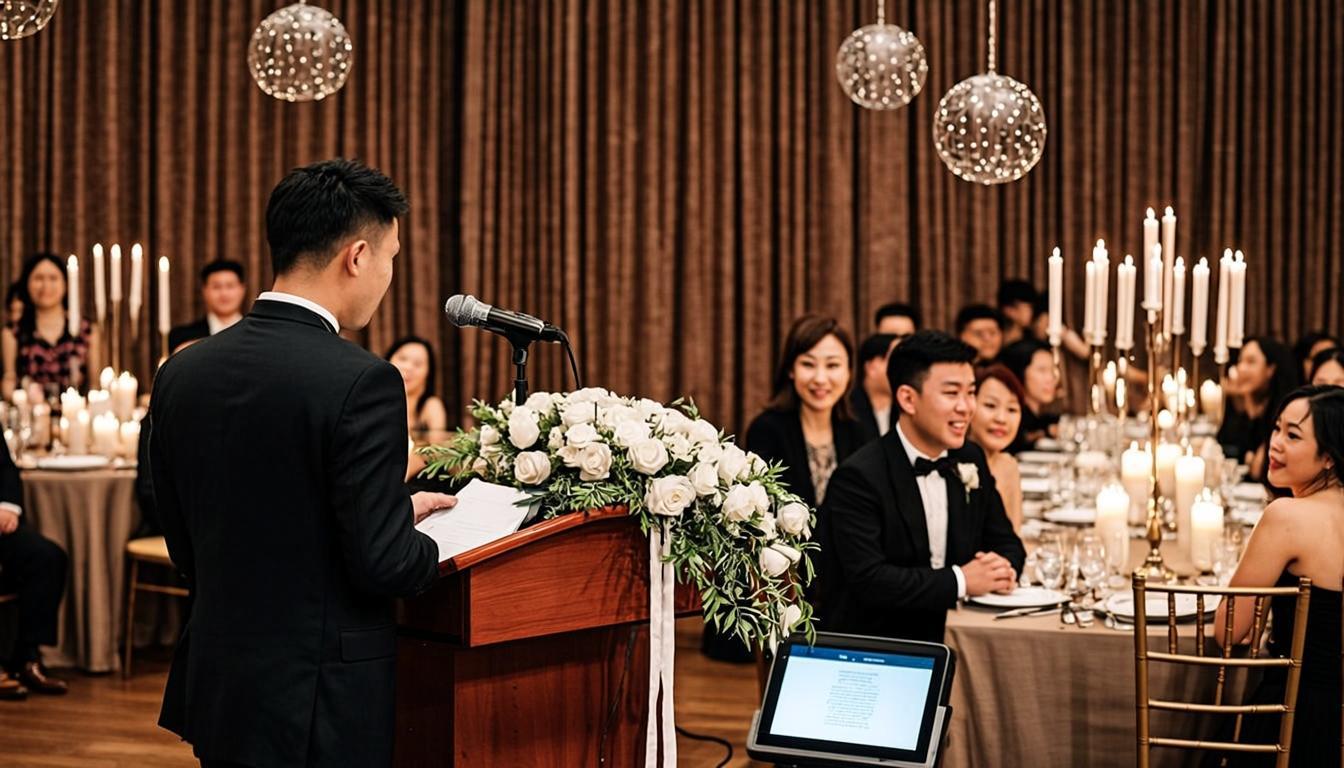
How to Use a Teleprompter for a Wedding Speech or Graduation
Don't let nerves ruin your big moment. A discreet teleprompter setup can help you deliver a flawless wedding speech, graduation address, or toast without memorizing a single word.
Standing up in front of a crowd to deliver a speech is one of the most nerve-wracking experiences most people will ever face. Whether it's a best man speech at your best friend's wedding, a maid of honor toast at your sister's reception, a graduation address to hundreds of your peers, or a eulogy at a memorial service, the stakes feel enormous. You want to say something meaningful, you want it to sound natural, and you absolutely do not want to forget what you planned to say. A teleprompter can be your secret weapon for these high-pressure moments, and no, it's not cheating.
Why a Teleprompter Beats Memorization for Special Occasions
Memorizing a speech sounds like the right approach until you actually try to do it. Under pressure, your brain does unpredictable things. You might remember the first half of your speech perfectly and then go completely blank. You might remember everything but deliver it in a flat, robotic voice because all your mental energy is going toward recall. Or you might panic halfway through and start rambling.
A teleprompter eliminates the memory problem entirely. You can focus on your delivery, your emotions, and your connection with the audience instead of trying to remember what comes next. The result is almost always a better speech: more heartfelt, more confident, and more engaging.
Choosing the Right Setup for the Venue
The venue matters a lot when it comes to teleprompter setup for live events. In a small, intimate wedding reception with fifty guests, you can get away with a very simple setup. An iPad on a small stand near the microphone, positioned at eye level, is completely sufficient. Most guests won't even notice it, or if they do, they'll assume it's just a tablet being used to take photos.
For larger venues like a graduation ceremony or a big wedding, you might have access to a confidence monitor, which is a screen positioned at the foot of the stage that displays your scrolling text. Many event venues have these available, and your event planner or AV team can usually set one up for you.
If you're speaking at a podium, check whether it has a built-in monitor or shelf where you can place a tablet or phone. Many modern podiums at universities and conference centers have this feature specifically for speakers who use notes.
Hiding the Teleprompter
One of the main concerns people have about using a teleprompter for a personal speech is that it'll look inauthentic. The good news is that there are several ways to make your teleprompter setup virtually invisible to the audience.
First, use a tablet rather than a laptop. An iPad mounted on a small stand looks like a notes tablet, which is perfectly normal at any event. Nobody will question it.
Second, position the screen directly behind the microphone or at the edge of the podium where it's naturally obscured. The microphone and podium create visual barriers that hide the screen from the audience while keeping it clearly visible to you.
Third, consider a beam splitter attachment on a small stand. These are the same devices used for camera teleprompters, but mounted on a tabletop stand near the podium. They look like a small glass panel on a stand, and to the audience, they look like a piece of event equipment rather than a teleprompter.
For truly discrete setups, you can even use your phone. Place it flat on the podium, angled slightly toward you, with the screen brightness turned up. From the audience's perspective, it just looks like you have your phone sitting on the podium, which is so common that nobody will think twice about it.
Writing a Speech That Sounds Natural
Writing for a teleprompter at a live event is different from writing for a video. In a video, you can do multiple takes. At a live event, you get one shot. Your script needs to be bulletproof.
Write the way you speak. This is the single most important rule. Read every sentence aloud and ask yourself: would I actually say these words in front of a room full of people? If a sentence feels too formal, too clever, or too literary, simplify it.
Include emotional cues in your script. Write things like "pause here" or "look at the couple" or "slow down" directly into the text. These stage directions remind you to slow down, connect with specific people, and let the emotional moments breathe. When you're nervous, time feels distorted and you tend to rush. These cues act as brakes that keep you grounded.
Delivering with Emotion
The hardest part of using a teleprompter for a personal speech is maintaining emotional authenticity while reading from a screen. This is a real challenge, but it's entirely possible with practice.
The key is to not actually read the words off the screen. Instead, glance at the prompter to get the next phrase or sentence, look up at your audience, and then say it. Think of the teleprompter as a memory aid, not as something you're reading aloud. You're looking at a reminder of what you want to say, and then you're saying it in your own voice with your own emotion.
Practice this technique repeatedly before the event. Read a sentence from your prompter, look up, and deliver it. Then read the next one, look up, and deliver that. With practice, this becomes a smooth, natural rhythm that's indistinguishable from speaking without notes.
Practice Techniques
Start practicing with your teleprompter setup at least a week before the event. Stand up, use the same device you'll use at the venue, and practice in front of a mirror or, even better, record yourself on your phone. Watch the playback and look for moments where your delivery feels stiff or where you lose eye contact with the imaginary audience.
Practice your speech at least ten times before the big day. By the fifth or sixth run-through, you'll notice that you're relying less on the prompter and more on the familiarity you've built with the material. This is exactly what you want. The teleprompter becomes a safety net, not a crutch.
Handling the Unexpected
At live events, unexpected things happen. Someone might laugh loudly at an unexpected moment, a baby might start crying, or the microphone might cut out briefly. Your teleprompter gives you a huge advantage in these situations because you can simply pause, wait for the disruption to pass, and then pick up right where you left off. Your script is still there, waiting for you, and you don't have to frantically remember what you were about to say.
Using a teleprompter for a special occasion speech isn't about being perfect. It's about being present. When you don't have to worry about remembering your words, you can focus entirely on the people in front of you and the moment you're sharing together. And that's what makes a great speech truly memorable.